

The colour comes from real stained glass, not a printed effect. These handmade Tiffany-style lamps have shades assembled from individually cut and arranged pieces of glass, joined using the traditional copper-foil technique. The result is a coloured shade with the character of handworked glass.
That craftsmanship is part of their appeal, but choosing a lamp involves more than admiring its pattern. Consider how its style will suit your room and how its light will feel in the evening. A table lamp and a floor lamp can each bring colour and warmth, in different ways.
This guide explains what stained-glass construction involves, how floral, geometric and other styles shape a lamp’s look, and what affects prices across the wider market. It also explores how bulb colour and brightness influence the glow through the glass, with particular attention to Tiffany floor lamps and the pool of light they can bring to a quiet corner.
Key Takeaways
- Learn how individually cut glass and copper foil create the shade’s distinctive colour and texture.
- See how floral and geometric patterns can bring different moods to a room.
- Understand why the bulb’s warmth and brightness can change the way coloured glass looks after dark.
- Compare the role of a table lamp with a floor lamp when planning a pool of light for reading or relaxing.
- Discover which details to consider when choosing a handcrafted shade for your space.
How Tiffany-style table lamps create light effects
A Tiffany-style table lamp changes character when its bulb glows behind coloured glass. Light passes through some pieces and meets darker seams, bringing the pattern forward. Tiffany Studios New York began producing handmade stained-glass lamps in 1895. Its original work belongs to the late 19th and early 20th century, yet the basic effect remains familiar: colour becomes part of the room’s lighting, not simply decoration.
Think of the shade as accent lighting rather than a ceiling pendant. Its glow sits close to a table, sideboard or reading chair. A green-and-amber floral shade, for example, can add colour to a quiet corner without lighting every surface evenly. This local pool of light helps define a seating area and works especially well alongside softer general lighting, rather than as the room’s only source.
Glass also shapes how the light travels. A Tiffany-style bedside shade directs some illumination downwards, while softer light spreads outwards through the glass. Together, these effects can support reading and create a calmer ambient glow. The result depends on the shade’s shape and colours, as well as the bulb’s position. An opaque section behaves differently from a pale, translucent piece.
Glare needs a little thought. A bright bulb can make a shade vivid, but may feel sharp when viewed directly. Try placing the lamp beside, rather than directly in front of, your usual chair, then check the effect from seated eye level. In a small room, pairing a table lamp with a ceiling light can balance decorative colour with broader illumination. An Art Deco geometric shade may cast a more patterned impression than a softer floral design.
Replica Tiffany lights vary in price across the UK market. Differences reflect factors such as shade size, glass colours, pattern complexity and the lamp’s base. A small bedside design and a larger, detailed table lamp meet different needs. Compare the glasswork, proportions and intended use rather than judging value by the motif alone. The individual glass pieces and copper-foil joins are also part of a handmade shade’s appeal.
A Tiffany-style appearance alone doesn’t establish whether a lamp is safe or UK-compliant. Before buying, check its safety documentation and markings, examine the plug and cable, and follow the maker’s bulb guidance. For everyday use, keep the lamp stable on a level surface and avoid using a bulb above its stated limit.
Are the shades made from genuine stained glass?
Yes. Stained-glass shades use individual pieces of coloured glass, joined into a patterned whole. The way those pieces meet shapes both the shade’s appearance and its glow.
Handcrafted stained-glass construction
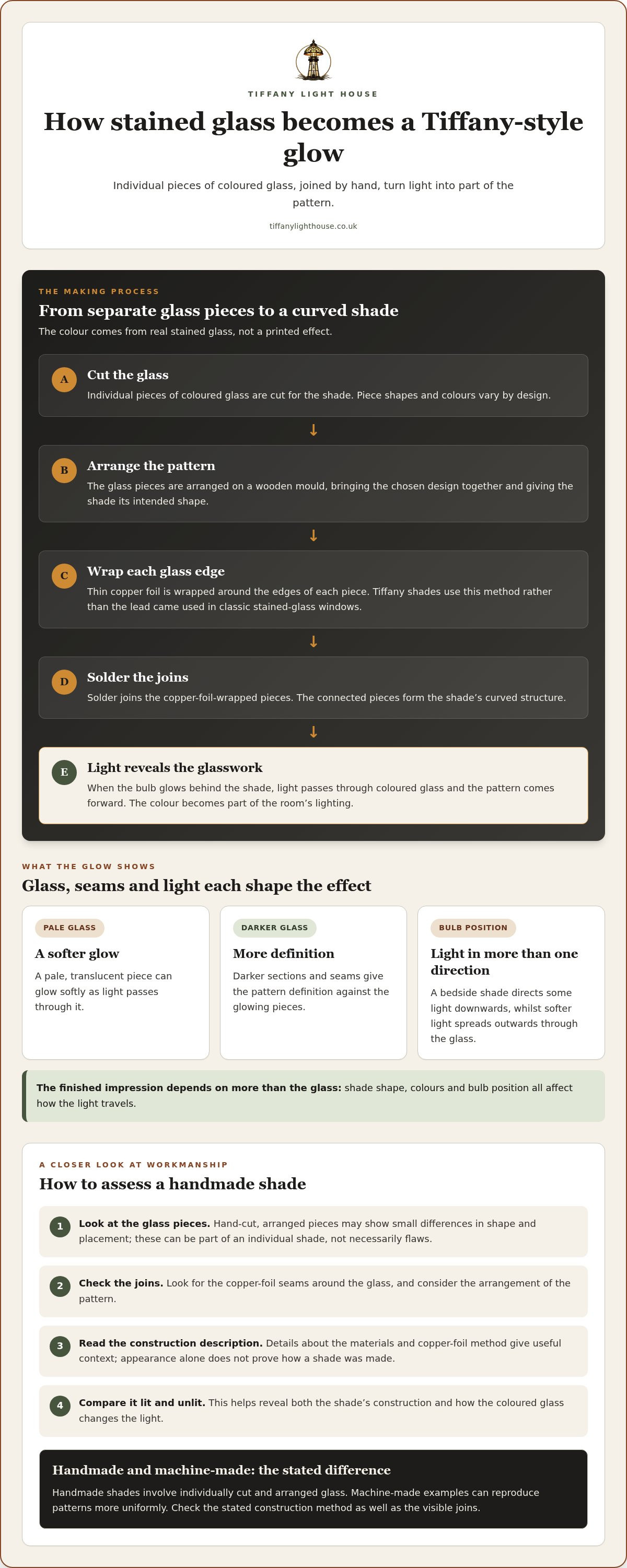
How are handmade Tiffany-style lamps made? Each glass piece is cut, arranged on a wooden mould and wrapped in thin copper foil. The foil edges are soldered together to form the shade’s curved structure. Unlike classic stained-glass windows, Tiffany shades use copper foil rather than lead came. This method allows smaller pieces to be arranged closely in detailed patterns.
Light reveals the craft. It passes through coloured glass, making differences in shade and texture visible. A pale piece may glow softly, while a darker section gives the pattern definition. Look at the arrangement from both sides, then view it with the lamp switched on. This simple step shows how the glass changes the room’s light.
Glass, solder and other materials
What glass, solder and materials are used in Tiffany-style lamps? The shade is made from individual pieces of stained or coloured glass, copper foil and solder. The foil wraps each glass edge, and solder joins the wrapped pieces. The assembled shade takes shape over a wooden mould. Glass colours and piece shapes vary by design, so inspect the pattern and its joins together.
Care helps protect the glass and its joins. Switch the lamp off and let it cool before cleaning. Use a soft, dry cloth to remove dust from the shade. For marks, use a lightly damp cloth, then gently dry the area. Avoid abrasive pads and pressing hard on the solder lines. Regular, gentle dusting keeps the coloured glass clear.
Recognising handmade workmanship
How can you tell if a Tiffany-style lamp is genuinely handmade? Look closely at the glass pieces, copper-foil seams and pattern. Hand-cut, arranged pieces may show small differences in shape and placement. These details are part of each individual shade, not necessarily flaws. A description explaining the materials and copper-foil method gives useful context. Compare the shade when lit and unlit to see its construction clearly.
How do handmade Tiffany-style lamps compare with machine-made lamps? Handmade shades involve individually cut and arranged glass, while machine-made examples can reproduce patterns more uniformly. Neither appearance alone proves how a shade was made. Check the stated construction method, then look for visible joins around the glass. For a closer look at handcrafted stained-glass lighting, compare how each design uses colour and pattern.
Tiffany table lamp styles and prices
Floral designs, geometric patterns and natural forms create different moods. Peonies, poppies and daffodils bring an Art Nouveau character. Geometric Tiffany lamp patterns reflect Arts and Crafts design. Dragonfly motifs draw on Japonisme and Louis Comfort Tiffany’s study of nature. Choose a design that complements the room, then consider how its colours appear when lit.
Look beyond the motif. A small table lamp suits a bedside table or narrow shelf, while a larger shade can anchor a side table. The base also affects the overall impression. A detailed shade paired with a simple base feels different from a lamp where both parts carry strong decoration. Check the proportions against the surrounding furniture.
Product prices depend on more than the style name. Shade dimensions, the number and arrangement of glass pieces, pattern detail and base materials all influence the work involved. Compare lamps by their construction and scale, not by motif alone. A compact floral design and a larger geometric shade may differ substantially in materials and making time.
Original Tiffany Studios lamps occupy a separate market from contemporary Tiffany-style designs. Auction prices for originals reflect factors such as rarity, condition, provenance and the appeal of a particular pattern. A Tiffany lotus table lamp sold in 1997, while a cobweb lamp with a glass mosaic base sold in 1992. Those auction results describe collectible originals, not a guide to the price of a modern table lamp.
When comparing lamps, consider the shade’s glasswork, the base and the intended setting. Ask yourself whether the colour palette will sit comfortably beside your existing furnishings. Then assess the overall scale and how much visual detail the room can hold. These practical comparisons help explain why similar-looking designs can have different price points.
Can you commission a bespoke handmade Tiffany-style lamp in the UK? Bespoke commissions are possible, but they are distinct from ready-made lamps. A commission involves agreeing the design and materials before work begins, so a standard catalogue listing should not be treated as a custom order.
Keep the distinction clear between contemporary designs and collectible originals. A 2025 auction result for a magnolia floor lamp illustrates the separate interest in historic Tiffany work. For table lamps, the useful comparison remains the glass, pattern, size and base. Together, these details explain both the character of a design and the factors behind its price.
Listings provide useful reference points.
These examples span a broad range, so treat each amount as a product-specific reference rather than a universal price for a style. Check what the listing includes, especially postage, and compare the lamp’s scale, decoration and materials with the intended room.
Bulb type, colour temperature and brightness
A warm-white E27 LED is a useful starting point for a Tiffany-style shade. A colour temperature of 2,700 K brings out the warmth in coloured glass. It can make amber, red and yellow pieces feel soft and inviting. The same shade may look quite different under a cooler bulb. Choose the light for the room’s mood as well as the lamp’s fitting.
Brightness is measured in lumens, not watts. For a Tiffany lamp, a warm-white E27 LED rated at 400 to 600 lumens is a practical guide. The lower end suits a bedside table or quiet corner. The higher end can provide more useful light for nearby tasks. Always keep within the lamp’s stated bulb limits.
Coloured pieces absorb and filter some light. A 600-lumen LED inside a Tiffany shade may provide an effective room output of 300 to 400 lumens. The shade’s glass, shape and pattern affect how much light reaches the room. Treat the bulb rating as a guide, not the brightness you’ll experience across every surface.
For reading, position the lamp so its downward light falls onto the page. A warm 2,700 K bulb helps the shade retain a gentle glow around it. If the page seems dim, adjust the lamp’s position before changing to a brighter bulb. The shade directs and softens light, so its placement matters alongside the lumen rating.
Avoid cool-white or daylight-spectrum bulbs at 4,000 K or above. Their cooler cast can make traditional coloured glass appear less warm. Compare the lamp switched on with the room’s other lighting. For example, a cool ceiling light may make the shade’s amber sections look less golden. A warm bulb can help the glass and surrounding room feel more harmonious.
Choose in three steps. First, check that the bulb base matches the fitting, such as E27. Next, select warm white at 2,700 K. Then choose a brightness between 400 and 600 lumens, guided by whether the lamp is for accent lighting or reading. This method gives a considered starting point without losing the quiet colour that makes Tiffany glass distinctive.
One bulb won’t suit every room. A 400-lumen option can give a small bedside lamp a gentler presence, whilst 600 lumens may suit a larger shade or a reading spot. Remember that the glass reduces and colours the light. Let the shade’s pattern, the task and the desired atmosphere guide your final choice.
Tiffany floor lamps
A floor lamp brings coloured glass higher into the room. It can stand beside an armchair, sofa or reading corner, where its shade creates a distinct pool of light. Unlike a table lamp, it doesn’t need a side table. Consider the space around the base, the shade’s height and where you’ll sit before choosing its position.
Style changes the mood. An Art Nouveau design can bring flowing floral forms, while a geometric shade gives a room clearer lines. Dragonfly patterns draw on Japonisme and Louis Comfort Tiffany’s study of nature. Match the pattern to nearby furnishings, or let it become a focal point among simpler shapes.
Placement matters as much as the motif. Put a floor lamp beside a chair to create a reading nook, then check that the shade’s light reaches the page. A Tiffany floor lamp can also soften an unlit corner. If the room already has a ceiling light, use both sources in layers: broader illumination overhead and colour close to the seating.
Think about movement through the room. Keep the lamp clear of doorways and walkways, and position its base on a level surface. For example, beside a sofa, place it where the shade remains visible without obstructing an end table. This makes the lamp part of the setting, rather than an obstacle beside it.
The shade is central to the effect. Individually cut and arranged glass forms the pattern, while the copper-foil technique joins the pieces. Examine how the design looks from your usual seat, both switched on and off. A detailed Dragonfly shade may draw the eye, while a simpler geometric pattern can sit more quietly in a room.
Floor-lamp prices vary with the shade’s size, glass colours, pattern detail and base. Intricate designs arrange glass pieces differently from simpler patterns. Compare these features alongside the lamp’s scale and intended position. A two-light design also distributes illumination differently from a single-light form, so consider the effect you want before comparing styles.
For a considered choice, picture the lamp beside your favourite chair and note the room’s existing light. Then browse Tiffany floor lamp designs to compare patterns and forms for your space.
These examples give you a point of comparison when considering which styles and forms may suit your room. Assess each option against the available space, nearby furnishings and the kind of light you want beside a chair or sofa. Price alone cannot show how a lamp will look in your room, so consider its scale and intended position too.
Before choosing, picture the lamp in the place where you’ll use it and consider how its shade will look from your usual seat. Compare the designs with the room’s existing light, and decide whether you want the lamp to stand out or blend with simpler shapes. Listed prices offer a practical starting point for comparing these floor-lamp options, while pattern, form and placement help determine which one suits your space.
Tiffany Light House: Tiffany Ceiling Lights
Tiffany Light House brings coloured-glass craftsmanship to lighting throughout the home. Its Tiffany Ceiling Lights extend stained-glass patterns beyond a table or reading corner. The collection also includes Tiffany Floor Lamps, Tiffany Table Lamps and Tiffany Wall Lights, making it easy to consider different forms of light together.
Each shade is made by hand from individually cut and arranged glass, joined using the traditional copper-foil technique. This detail may help guide your choice if you’re drawn to the texture and variation of handmade glass. Free UK delivery and free 30-day returns are available.
Explore the lighting range, or visit Tiffany Light House online.
Choose the light that feels at home
Let the room guide your next step. A lamp beside a favourite chair can make an everyday pause feel more settled. A light above the dining table can shape the atmosphere around it. First consider where you want the light, then which form feels right in that space.
Handmade Tiffany-style lamps bring colour and pattern into a room, but where you place one matters just as much. Consider the nearby furnishings, when you’ll use the light and whether you want it to sit quietly or become a focal point. A thoughtful choice can feel personal without asking the rest of the room to change.
If you’re ready to explore a table, floor or ceiling design, Tiffany Light House offers each of these lighting styles. Contact Tiffany Light House to take the next step towards a lamp that feels at home in your space.
Frequently Asked Questions
What size Tiffany lamp is best for a bedside table?
A shade between 8 and 12 inches in diameter is a useful starting point for a standard bedside table. Measure the available surface first, including space needed for a book, phone or glass of water. A compact table may suit the smaller end, whilst a wider bedside surface can accommodate a larger shade without crowding the essentials.
How much do handmade Tiffany-style lamps cost in the UK?
There isn’t one price for handmade Tiffany-style lamps. The amount depends on the shade’s dimensions, the intricacy of its glass pattern, the materials and the base. Compare lamps with similar proportions and construction to understand what each listing includes. A simple design and an elaborate shade may have different price points, even when both suit the same room.


